Nami Award 3
3rd NAMI Award 2017
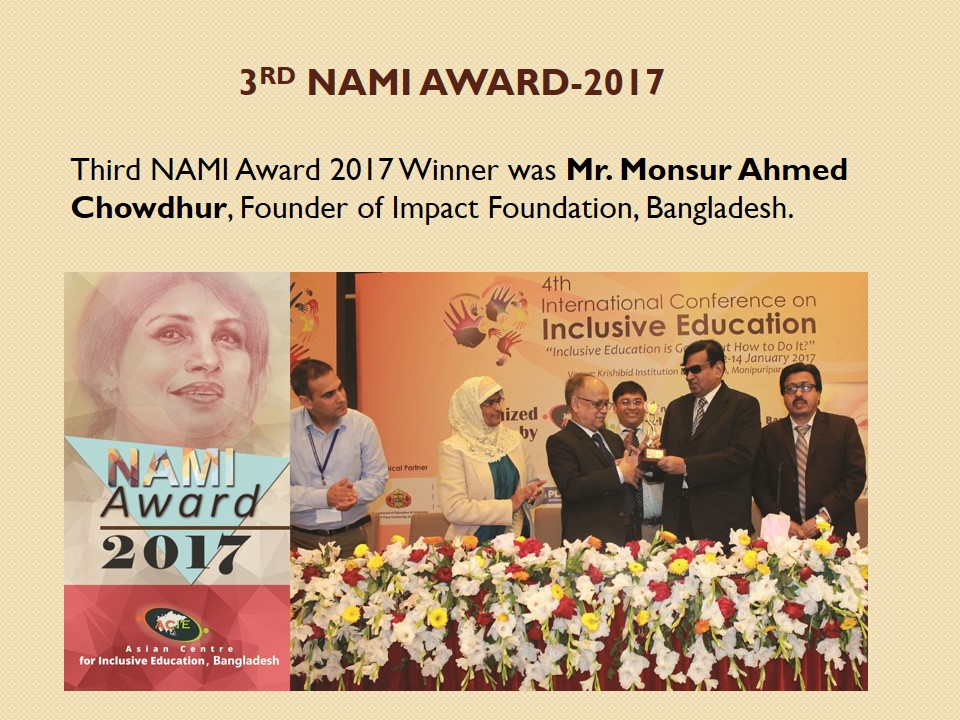
 He was the first ever student in the Rotary school for the blind established in Dhaka in 1957. Mr Chowdhury completed education from University of Dhaka with Masters Degree in Public Administration in 1974 and BA (Hons) in Political Science in 1972 respectively. He started professional career in 1978 as the Executive Officer of the Bangladesh National Society for the Blind. He served 15 years in different organizations at home and USA to promote rights and services of the visually impaired people. Later, he is one of the founders of Impact Foundation Bangladesh in 1993 along with 4 other dedicated social workers to prevent avoidable disabilities, inspired and supported by Late Sir John Wilson CBE, Chairman, UK Impact Foundation. IFB operates two hospitals in Chuadanga and Meherpur, and the pioneering floating hospital – Jibon Tori. The Jibon Tori (boat of life) travels through rivers of Bangladesh to reach out to millions of rural people. This innovative initiative has given opportunity to provide modern medical services at the doorsteps of poorer community in riverine areas. Since 1993, while this has remained his primary job responsibility as Director of this Foundation, Mr. Monsur Chowdhury has also been involved in numerous other initiatives concerning the overall advancement of the disability development sector. His activism and work has taken him to almost 44 countries, and he has contributed in this sector most extensively. Mr Chowdhury was also instrumental in establishing the National Forum of Organizations Working with the Disabled (NFOWD) as National Network and Platform for Cross Disability Movement in Bangladesh since 1993. This forum played a vital role in securing from the Government of Bangladesh the National Policy on Disability (1995), the Disability Welfare Act (2001) and the National Action Plan on Disability (2006). This is a true example of GO-NGO collaboration, recognized by UN ESCAP as one of its best practices in this Region. Rights of Persons with Disability and Protection Act (2013) has replaced the earlier Act, pursuing by NFOWD in line and spirit of UNCRPD.